

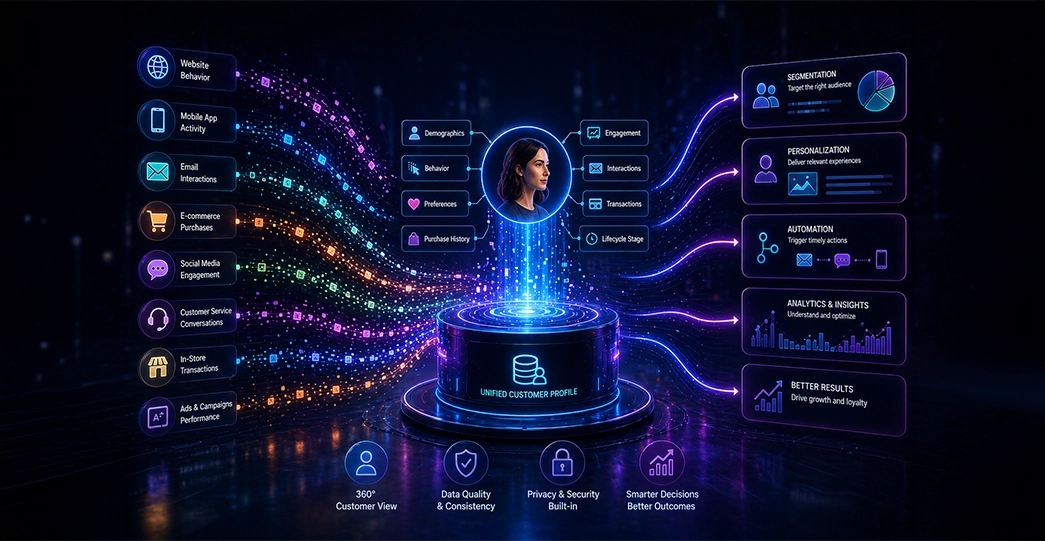
The average enterprise now uses multiple marketing, analytics, and sales tools, yet data fragmentation remains one of the most reported challenges. 54% of marketers say disconnected data limits their ability to deliver personalized experiences (source: Salesforce State of Marketing). At the same time, companies that apply advanced personalization can increase revenue by up to 20% (source: McKinsey). The gap between these two numbers is not about effort. It is about structure. This is where a Customer Data Platform (CDP) becomes critical.
A Customer Data Platform, or CDP, is a centralized system designed to collect, unify, and manage customer data from multiple sources into a single, persistent profile. It does not just store data. It connects identity, behavior, and transactions into one usable layer for marketing and decision-making.
The Structure and Role of a Customer Data Platform
A Customer Data Platform is a centralized system that collects, unifies, and manages customer data from multiple sources, creating a persistent and accessible profile for each user. It acts as the foundation for data-driven marketing, customer insights, and marketing automation, allowing companies to move from fragmented datasets to a consistent and actionable view of the customer. According to the CDP.com, a modern Customer Data Platform is not only about gathering Data, it must serves as the base for Data Driven and AI Driven marketing.
What a CDP Actually Does and How It Works
At its core, a CDP is built around a set of critical functionalities that transform raw data into operational value:
- Data collection from websites, mobile apps and external tools
- Identity resolution that connects multiple identifiers such as email, device ID, and browsing behavior
- Profile unification to create a single, reliable customer view
- Customer segmentation based on behavior, demographics, and transactions
- Data activation across channels like email, advertising platforms, and messaging systems
These capabilities operate within a clear pipeline. Data is first ingested from multiple sources, then cleaned and standardized to remove inconsistencies. Identity stitching links fragmented signals into a single user identity. This leads to unified customer profiles that can be activated in real time across marketing channels. This structured flow enables real-time personalization and omnichannel marketing execution.
The value of a CDP depends on the depth and diversity of the data it processes. Typically, four main types of data are integrated:
- First-party data, including direct interactions such as website visits
- Behavioral data, capturing user actions like clicks and session activity
- Transactional data, recording purchases and revenue patterns
- Demographic data, adding context such as location or age
Understanding how a CDP differs from other systems is essential. A CRM focuses on managing customer relationships and sales pipelines. A DMP works primarily with anonymous third-party data for advertising. A CDP, in contrast, creates persistent and identifiable profiles, making it central to customer journey optimization and behavioral targeting.
Modern CDPs are defined by a set of key features that extend beyond storage:
- Real-time data processing for immediate insights
- AI-driven segmentation to identify high-value audiences
- Integration capabilities with marketing and analytics tools
- Privacy controls to manage consent and compliance
- Omnichannel activation across multiple communication channels
These features directly translate into business outcomes. Improved customer personalization, deeper customer insights, higher retention rates, and more efficient marketing campaigns are consistently reported benefits. According to Bain and Company, increasing customer retention by just 5% can increase profits by 25% to 95% (source: Bain & Company).
Business Applications, Industry Adoption, and Strategic Impact
The practical value of a CDP becomes visible through its use cases. Companies apply CDPs to execute:
- Personalized email campaigns based on real-time behavior
for example you want to send ads to the users interested in specific category of products on your website - Retargeting strategies for abandoned users
sending reminder to users about the unfinished purchases and the items in their basket. - Churn prediction using behavioral and transactional data
- End-to-end customer journey optimization across channels
Netflix uses unified customer data platform and machine learning models to power its recommendation system, which then drives more than 80% of content consumption (source: Netflix Tech Blog). This demonstrates the impact of predictive analytics and data unification at scale.
Amazon leverages customer browsing and purchase data to deliver personalized product recommendations. Also McKinsey reports that these recommendation engines contribute to approximately 35% of Amazon’s revenue (source: McKinsey). This is a direct example of data activation influencing revenue.
Starbucks integrates customer data from its mobile app and loyalty program to deliver personalized offers and promotions. This strategy has significantly increased customer engagement and repeat purchases (source: Starbucks Investor Relations). It reflects the power of first-party data strategies combined with automated segmentation.
CDPs are widely adopted across industries where customer interaction data is critical:
- E-commerce for personalization and retention
- Fintech for segmentation and fraud detection
- SaaS for onboarding and product engagement
- Telecom for churn reduction
- Media for content personalization
The effectiveness of a CDP depends heavily on its integration within the broader marketing technology stack. A CDP connects seamlessly with email platforms, ad networks, analytics tools, and other systems, ensuring that every tool operates on consistent and unified data. Without this integration, marketing efforts remain fragmented and inefficient.
However, implementing a CDP is not without challenges. Organizations often face:
- Data silos across departments
- Integration complexity with existing and third party systems
- Data quality issues affecting accuracy
- Internal alignment challenges between teams
Another critical dimension is data privacy and compliance. Regulations such as GDPR require strict consent management and secure data handling, therefore CDPs must ensure transparency and compliance while maintaining usability.
Selecting the right CDP requires careful evaluation of several factors:
- Scalability to handle growing data volumes
- Ease of use for cross-functional teams
- Real-time processing for faster decision-making
- Pricing models aligned with business goals
CDP and AI Automation
The real shift in Customer Data Platforms (CDP) is not only about collecting and unifying data. because It is about making that data act without constant human intervention. This is where AI-driven marketing, predictive analytics, and automation become central.
A modern CDP does not wait for marketers to define every rule. It learns from behavioral data, transactional data, and customer interactions to predict what is likely to happen next.
At the core of this evolution is predictive analytics. Instead of analyzing past behavior only, CDPs use machine learning models to estimate:
- Probability of purchase
- Risk of churn
- Expected customer lifetime value
- Likelihood of engagement with a campaign
These predictions allow companies to move from reactive marketing to proactive decision-making. For example, instead of sending the same campaign to all users, a CDP can automatically prioritize high-intent users and suppress low-probability segments, improving conversion rate optimization and reducing marketing waste.
Another critical layer is the recommendation engine. Companies like Amazon and Netflix have shown how recommendation systems directly impact revenue and engagement. McKinsey reports that recommendation engines can drive up to 35% of revenue in e-commerce environments (source: McKinsey), while Netflix states that over 80% of watched content is driven by its recommendation system (source: Netflix Tech Blog).
These systems rely on continuous data input from a CDP, including browsing patterns, purchase history, and engagement signals. Without unified data, recommendation quality drops significantly.
A third dimension is automated segmentation, which replaces static audience definitions. Traditional segmentation depends on manual rules such as age, location, or past purchases. In contrast, AI-driven CDPs continuously update segments based on real-time behavior. A user can move from a low-intent segment to a high-intent segment within minutes, triggering different campaigns automatically.
This enables:
- Dynamic audience creation based on live behavior
- Real-time campaign triggering
- Personalized messaging across channels
- Continuous A/B testing and optimization
Automation then connects all these layers. Once predictive models and segmentation are in place, the CDP can trigger actions without manual input:
- Sending personalized emails based on predicted intent
- Launching retargeting campaigns for high-value users
- Adjusting offers based on customer lifetime value
- Optimizing customer journeys automatically
This is where marketing automation becomes truly data-driven. The system does not just execute campaigns. It decides who should receive them, when, and through which channel.
The result is a shift from campaign-based marketing to system-based marketing, where decisions are continuously optimized using AI models, real-time data processing, and customer behavior analysis.
Future Trends in Customer Data Platform (CDP)
The direction of CDPs is being shaped by two major forces: the decline of third-party data and the rise of intelligent automation.
The most immediate shift is toward cookieless tracking. As browsers restrict third-party cookies and regulations tighten, companies can no longer rely on external data sources for targeting. This change forces a transition toward first-party data strategies, where businesses collect and manage their own customer data directly.
This shift has several implications:
- Greater reliance on owned channels such as websites and mobile apps
- Increased importance of login systems and user identification
- Higher value placed on customer data ownership
- Reduced dependency on external ad platforms
In this environment, a CDP becomes the central infrastructure for managing first-party data. It ensures that every interaction, from anonymous visits to logged-in behavior, is captured and connected.
At the same time, AI integration is becoming deeper and more operational. Earlier versions of Customer Data Platforms focused on data storage and segmentation. The next generation focuses on decision-making.
Future CDPs will increasingly include:
- Self-learning models that improve over time without manual tuning
- Predictive journey orchestration across multiple channels
- Automated budget allocation based on performance signals
- Real-time personalization at scale across millions of users
This is already visible in companies that heavily rely on data. Spotify uses machine learning to personalize playlists such as Discover Weekly, driven by user behavior and listening patterns (source: Spotify Engineering). This is not just a feature. It reflects how deeply AI and customer data platforms are integrated into product and marketing strategies.
Another trend is the convergence of CDPs with broader marketing technology stacks. Instead of being a separate layer, Customer Data Platforms are becoming the central system that connects analytics, messaging, advertising, and product data into a single operational flow.
Finally, privacy and compliance will continue to shape CDP architecture. Regulations like GDPR require not only secure data handling but also transparent and user-controlled data usage. Future CDPs will need to embed privacy controls directly into their core logic, not as an additional layer.
In practical terms, the future CDP is not just a data platform. It is an intelligent system that combines data unification, AI-driven insights, and automated execution into one continuous process.
Examples of CDP platforms include Segment, Salesforce, and Adobe, each offering different levels of integration, scalability, and enterprise capabilities.
For companies looking to move beyond data collection and into execution, AlgorithmX provides a practical and results-driven approach. By combining customer data platform capabilities, AI-driven segmentation, and automated omnichannel messaging, AlgorithmX enables businesses to transform unified data into measurable outcomes such as higher conversion rates, improved retention, and more efficient marketing automation strategies.
In summary, a CDP is not just a data system. It is the operational layer that connects customer data, AI, and marketing execution, making data-driven growth possible.
Final Point
While traditional marketers try to find and get more new clients by advertising and try to keep customers by branding strategies, thus modern marketing emphasizes on repeating sales by current clients and loyalty strategies by getting to know them and their behaviours. Repeating sales and Loyalty strategies are for sure cheaper and more profit generating comparing to advertising. In this process Most companies do not fail because they lack data, they fail because their data cannot make decisions. Also on the other hand it is important to note that a CDP does not create value only by organizing data. It creates value when data starts influencing decisions before teams even request insights.